Affiliate marketing has changed a lot over the past few years. It used to be possible to build a small affiliate website by publishing a few product reviews, adding some affiliate links, and waiting for visitors to arrive from Google. Today, competition is much tougher. Readers expect useful information, search engines are better at understanding content quality, and successful affiliate marketers often have to create content across several channels at once. That’s where AI can be incredibly useful.
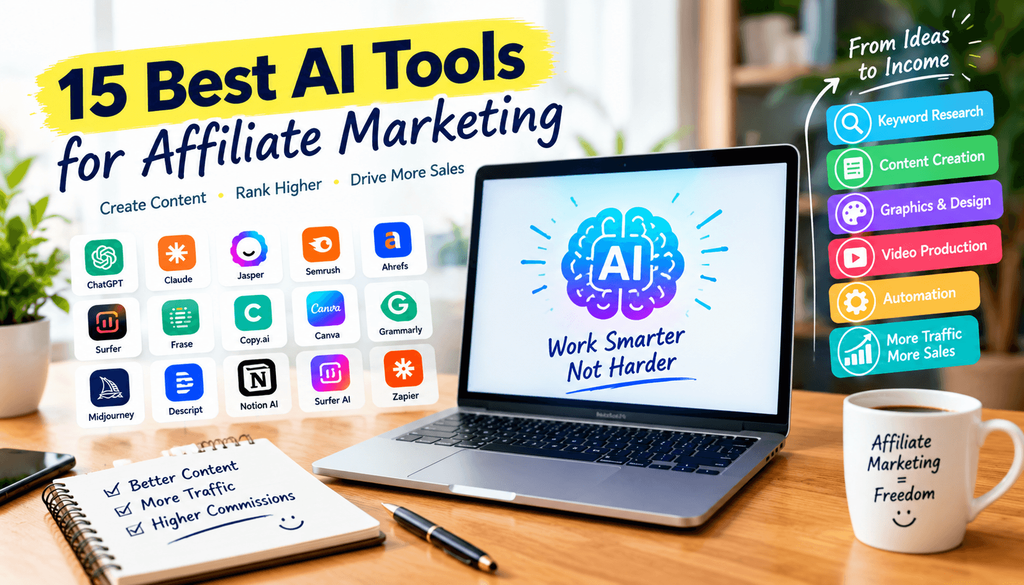
The 15 Best AI Tools for Affiliate Marketing can help you research keywords, find content opportunities, write and edit articles, create graphics, produce videos, analyze competitors, and automate repetitive marketing tasks.
But there’s a catch: AI isn’t a magic button for making affiliate commissions. Publishing hundreds of generic AI-written articles won’t automatically bring traffic or sales. The marketers who get the most from these tools use AI to save time while still adding their own research, experience, opinions, and understanding of their audience.
In this guide, we’ll look at 15 of the best AI tools for affiliate marketing, what each tool is good at, and how you can actually use them to build a more efficient affiliate marketing workflow.
What Are AI Tools for Affiliate Marketing?
AI affiliate marketing tools are software platforms that use artificial intelligence to help with tasks involved in promoting products and earning commissions.
Depending on the tool, AI can help you with:
- Keyword research
- Content creation
- SEO optimization
- Competitor research
- Product comparisons
- Email marketing
- Social media content
- Graphic design
- Video production
- Content editing
- Marketing automation
- Data analysis
The important thing is that these tools don’t all solve the same problem.
For example, an SEO platform can help you discover keywords and analyze competitors, while an AI writing assistant can help turn your research into an organized article. A design platform can help you create social media graphics, while an automation tool can connect different parts of your marketing workflow.
So rather than looking for one tool that does everything, it’s usually smarter to build a small collection of tools that fit the way you work.
15 Best AI Tools for Affiliate Marketing
1. ChatGPT — Best Overall AI Tool for Affiliate Marketers
ChatGPT is one of the most flexible AI tools available to affiliate marketers.
You can use it during almost every stage of an affiliate marketing campaign. It can help brainstorm niche ideas, generate content topics, create outlines, explain complicated subjects, improve drafts, write email sequences, develop social media posts, and help organize research.
For example, let’s say you’re running an affiliate website in the home fitness niche.
Instead of asking ChatGPT to simply “write an article about treadmills,” you could ask it to brainstorm topics based on different stages of the buyer journey:
- Best treadmills for small apartments
- Treadmill vs. exercise bike
- What to look for when buying a treadmill
- Best budget treadmills
- Treadmills for beginners
- Common treadmill mistakes
That gives you a much more useful content plan.
ChatGPT is also valuable for repurposing content. A long product comparison can be transformed into social posts, an email newsletter, a video outline, or a list of questions for a YouTube review.
Best for: Content planning, brainstorming, writing assistance, research organization, and content repurposing.
2. Claude — Best for Long-Form Content and Editing
Claude is another AI assistant that can be useful for affiliate marketers, especially when working with lengthy documents.
Affiliate websites often accumulate large amounts of research, product specifications, notes, customer questions, and existing articles. Reviewing all that information manually can take hours.
Claude can help summarize information, analyze drafts, identify gaps, improve organization, and make long-form content easier to work with.
One particularly useful application is content editing.
Instead of asking an AI to write your entire article from scratch, you can provide your own draft and ask it to identify areas where the explanation is unclear, repetitive, or difficult to follow.
That approach often produces better results because you’re using AI as an editor rather than allowing it to replace your voice.
Best for: Long-form writing, editing, summarization, and content analysis.
3. Jasper — Best for Marketing Content
Jasper is designed with marketing teams and content creators in mind.
Affiliate marketers can use it to create marketing copy for blog posts, emails, landing pages, social media campaigns, advertisements, and promotional content.
One of the advantages of using a marketing-focused AI platform is consistency. If you’re building an affiliate brand, you don’t want your website to sound professional on Monday and completely different on Friday.
Maintaining a consistent tone can make your brand more recognizable and trustworthy. Jasper can be particularly useful for marketers managing multiple channels and producing content regularly.
Best for: Marketing copy, promotional campaigns, brand voice, and content production.
4. Semrush — Best for SEO and Keyword Research
Getting affiliate content in front of potential buyers is one of the biggest challenges in affiliate marketing. That’s why SEO tools are so important.
Semrush provides tools for keyword research, competitor analysis, SEO monitoring, content planning, and other areas of digital marketing. Its AI-powered features can also assist with content-related tasks.
For an affiliate marketer, keyword research is particularly valuable.
Instead of guessing what people want to read, you can investigate search queries related to your niche and identify topics that may have commercial or informational intent.
For example, someone searching for “how to choose running shoes” is looking for information, while someone searching for “best running shoes under $100” is much closer to making a purchase. Understanding this difference helps you create content for different parts of the buyer journey.
Best for: Keyword research, competitor analysis, SEO strategy, and content planning.
5. Ahrefs — Best for Competitor and Backlink Research
Ahrefs is another popular SEO platform that affiliate marketers can use to understand search competition. Its tools can help you research keywords, analyze backlinks, investigate competing websites, and find content opportunities. One useful strategy is competitor content analysis.
Suppose another affiliate website consistently ranks for product comparison keywords in your niche. You can study which topics attract traffic, what keywords those pages target, and how other websites link to them. You shouldn’t simply copy what competitors are doing.
Instead, use the information to identify opportunities to create something more comprehensive, more useful, or more focused on the questions your audience actually has.
Best for: SEO research, backlink analysis, competitor research, and keyword discovery.
6. Surfer — Best for Content Optimization
Writing an article isn’t enough if nobody can find it. Surfer is designed to help marketers optimize content for search engines by analyzing competing pages and identifying relevant topics and terms.
For affiliate marketers, this can be useful when optimizing product reviews, comparison articles, buying guides, and informational content.
Rather than repeatedly inserting your primary keyword, you can use an SEO content tool to understand the broader topic.
For example, an article about “best coffee machines” may naturally need to discuss things such as brewing methods, capacity, cleaning, price, features, maintenance, and ease of use. That creates a more complete resource for readers.
Best for: On-page SEO and content optimization.
7. Frase — Best for SEO Content Briefs
Frase combines content research, SEO, and AI writing features. One of its most useful applications for affiliate marketers is creating content briefs before you start writing.
A good content brief can help you understand:
- What questions readers are asking
- Which subtopics deserve attention
- What competing pages discuss
- How to structure an article
- Which related topics should be covered
This is especially useful if you’re producing lots of affiliate content. Instead of staring at a blank document and wondering what to write, you can start with a structured plan.
The result is often a more focused article that answers the reader’s questions in a logical order.
Best for: Content briefs, SEO research, topic coverage, and article planning.
8. Copy.ai — Best for Marketing Copy and Repurposing
Copy.ai focuses heavily on marketing and sales workflows.
Affiliate marketers can use it for email campaigns, social media copy, product descriptions, promotional content, and content repurposing. Repurposing is where tools like this can become particularly useful.
Imagine you’ve spent several hours researching and writing a detailed product comparison. That article contains plenty of information that could be used elsewhere.
You could turn the key points into:
- Five social media posts
- A short email
- A video script
- A product comparison graphic
- A short-form video outline
Instead of constantly creating ideas from scratch, you get more value from the research you’ve already done.
Best for: Copywriting, email marketing, social content, and content repurposing.
9. Canva — Best for Affiliate Marketing Graphics
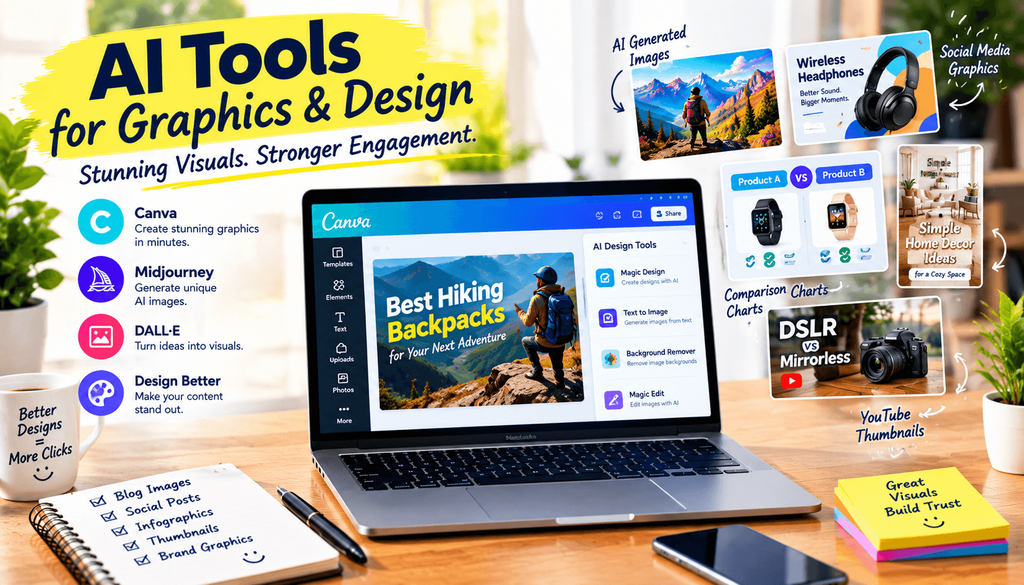
Affiliate marketing isn’t limited to Google search. Social platforms, Pinterest, YouTube, newsletters, and other channels can all send potential customers to affiliate content. That makes visual content increasingly important. Canva’s AI-powered features make it easier to create graphics without being a professional designer.
You can use it to create:
- Blog graphics
- Product comparison charts
- Pinterest pins
- Social media posts
- YouTube thumbnails
- Infographics
- Presentation graphics
For example, a simple “Product A vs. Product B” graphic can make a comparison article more attractive and easier to understand.
Just remember that AI-generated visuals shouldn’t be used to misrepresent a real product. When reviewing a physical product, accurate product images and screenshots are generally more useful to buyers.
Best for: Graphics, social media visuals, infographics, and thumbnails.
10. Grammarly — Best for Editing Affiliate Content
Even good affiliate content can lose credibility if it’s full of awkward sentences, typos, or unnecessary repetition. Grammarly can help improve grammar, spelling, clarity, tone, and readability. This is particularly useful when you’re using AI to help create content.
Instead of publishing the first AI-generated draft, you can edit it yourself and then use a writing assistant to identify areas that still need improvement. The goal isn’t to make every sentence sound perfect. The goal is to make your content easy and enjoyable to read.
Affiliate content works best when it feels like advice from a knowledgeable person rather than a sales brochure.
Best for: Proofreading, editing, readability, and tone.
11. Midjourney — Best for Creative AI Images
Midjourney can generate creative images from text prompts. For affiliate marketers, this can be useful for creating illustrations, conceptual images, social media visuals, and other creative assets.
For example, an affiliate website about interior design might use AI-generated images to illustrate different decorating concepts. However, there’s an important distinction between creative imagery and product representation.
If you’re reviewing a specific smartphone, laptop, camera, or appliance, an AI-generated image should not be presented as though it were a real photograph of that product. Use AI imagery where it adds creativity, not where accuracy is essential.
Best for: Creative illustrations, conceptual visuals, and social media content.
12. Descript — Best for Affiliate Video Content
Video is becoming an increasingly important part of affiliate marketing. Product reviews, tutorials, comparisons, demonstrations, and buying guides can all work well in video format. Descript uses AI to simplify video editing and transcription workflows.
One useful feature of an AI-assisted video workflow is the ability to turn one piece of content into several formats. For example, you could create a 10-minute product review and then extract several shorter clips for social media. You can also use the transcript to help create a written article or newsletter.
This type of content repurposing lets you reach people who prefer different formats without starting from zero every time.
Best for: Video editing, transcripts, short-form clips, and content repurposing.
Notion AI — Best for Organizing Affiliate Marketing Work
Affiliate marketing involves more organization than many beginners expect.
You might have:
- Hundreds of content ideas
- Keyword lists
- Product information
- Affiliate program details
- Publishing schedules
- Outreach notes
- Content updates
- Performance data
Notion AI can help organize and work with this information inside a centralized workspace. You can use it to summarize notes, brainstorm ideas, create content plans, and organize projects.
For a solo affiliate marketer, having a clear content calendar and research system can make a huge difference.
Instead of constantly wondering what to publish next, you can maintain a pipeline of ideas and prioritize them based on your strategy.
Best for: Content planning, organization, project management, and research notes.
14. Surfer AI — Best for AI-Assisted SEO Content
Surfer AI is designed to help create SEO-focused content. For affiliate marketers, it can be useful when you need to produce drafts around specific search topics. But there’s a major mistake to avoid: don’t treat an AI-generated article as a finished piece simply because it contains your target keyword.
Affiliate content needs more than keywords. Add firsthand observations, useful examples, product comparisons, original explanations, and information that helps the reader make a decision.
If you’re reviewing products you’ve actually used, include your experience. If you’re comparing products, explain why one might be better for a specific type of buyer. Those details are difficult to replace with generic AI text.
Best for: AI-assisted SEO content creation and article drafting.
15. Zapier — Best for Marketing Automation
Zapier isn’t primarily an AI writing platform, but it can be incredibly useful for affiliate marketers who want to automate repetitive tasks. It can connect different apps and create automated workflows.
For example, you could build a workflow that moves information between your project management system, spreadsheet, email platform, and other tools.
Automation becomes especially valuable once your affiliate business grows. You don’t want to spend your day copying information from one application to another or manually performing simple administrative tasks. The more repetitive work you can automate, the more time you can spend on content strategy, audience research, and improving conversions.
Best for: Workflow automation, productivity, and connecting marketing tools.
How AI Can Help You Build an Affiliate Marketing Workflow
The real value of these tools becomes clear when you combine them.
For example, a simple AI-powered affiliate content workflow could look like this:
Step 1: Find a Topic
Use an SEO platform such as Semrush or Ahrefs to research keywords and identify topics that match your niche.
Step 2: Analyze Search Intent
Determine what the searcher actually wants. Are they looking for information, comparing products, or ready to buy?
Step 3: Build the Outline
Use ChatGPT, Claude, or Frase to organize the topic into a useful structure.
Step 4: Do Your Research
Check product specifications, pricing, features, customer concerns, and other relevant information yourself. Don’t rely blindly on AI for factual product information.
Step 5: Write the Article
Use AI to help with drafting where appropriate, but add your own knowledge and perspective.
Step 6: Optimize for SEO
Use an SEO platform such as Surfer to review the article and identify opportunities to improve topical coverage and on-page optimization.
Step 7: Edit Everything
Read the article as a human reader. Remove unnecessary sentences, fix awkward wording, verify facts, and make sure the recommendations actually make sense.
Step 8: Create Supporting Content
Use Canva for graphics, Descript for video content, and AI writing tools for social posts or email newsletters.
Step 9: Automate Repetitive Tasks
Use Zapier to connect your tools and reduce manual administrative work.
This workflow allows AI to handle much of the repetitive work while you remain responsible for the strategy and final quality.
How to Choose the Best AI Tools for Affiliate Marketing
You don’t need to subscribe to all 15 tools. In fact, doing so would probably be unnecessary for most affiliate marketers.
- Start by asking yourself one question:
- What is currently slowing down my affiliate business?
- If you’re struggling with ideas, start with an AI writing assistant.
- If you can’t attract organic traffic, focus on SEO and keyword research.
- If your articles are difficult to read, use an editing tool.
- If you want to expand into YouTube or short-form video, consider an AI video platform.
- And if you’re spending hours on repetitive tasks, look into automation.
A simple affiliate marketing toolkit might only need three or four tools.
Is AI Good for Affiliate Marketing?
Yes, but only when it’s used properly. AI can make affiliate marketing more efficient by reducing the amount of time required for research, writing, editing, design, and repetitive tasks.
However, AI doesn’t automatically create trust. People still want honest recommendations. They want to know whether a product is worth buying, what its weaknesses are, who should buy it, and what alternatives are available. That’s why human input remains so important.
Use AI to accelerate your work, not to eliminate the work that gives your content its value.
Can AI-Generated Content Rank on Google?
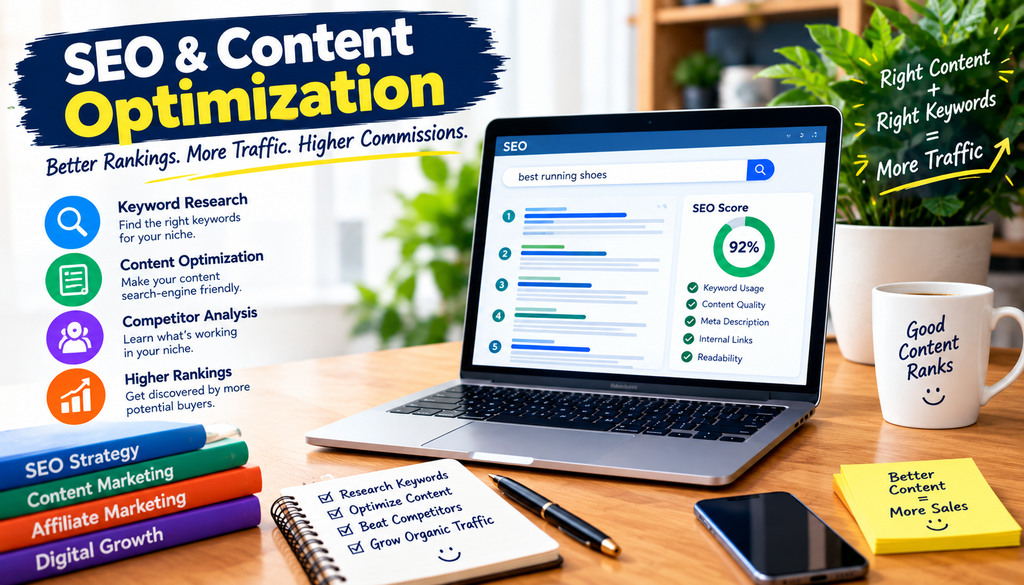
AI-assisted content can be useful, but ranking isn’t simply a matter of whether AI or a human wrote the article. Search engines care about the quality and usefulness of the content and whether it satisfies the searcher’s needs.
If an AI-generated article is generic, inaccurate, repetitive, or created mainly to manipulate search rankings, it isn’t likely to provide much long-term value. On the other hand, AI can help a knowledgeable creator research, organize, edit, and improve genuinely useful content.
The safest approach is to focus on the reader first and use AI as part of your production process.
Frequently Asked Questions
What is the best AI tool for affiliate marketing?
There isn’t one tool that is best for everyone. ChatGPT is a strong all-purpose option for brainstorming, content planning, writing assistance, and marketing tasks. SEO-focused marketers may get more value from platforms such as Semrush or Ahrefs, while visual creators may prefer Canva.
Can AI help beginners with affiliate marketing?
Yes. AI can help beginners with research, content planning, writing, SEO, social media, and organization. However, beginners should still learn the fundamentals of affiliate marketing rather than relying entirely on AI.
Can I use AI to write affiliate product reviews?
You can use AI to help organize research and create a draft, but you should verify product information and add genuine value. If you have firsthand experience with a product, include those observations. Avoid publishing generic AI-generated reviews without meaningful research.
Is AI affiliate marketing profitable?
AI can make affiliate marketing more efficient, but profitability depends on factors such as niche selection, traffic, content quality, audience trust, affiliate commissions, and conversion rates. AI itself doesn’t guarantee income.
How many AI tools do affiliate marketers need?
Most marketers don’t need dozens of tools. A small stack covering content creation, SEO, design, and automation can be enough. Start with the areas where you’re losing the most time and add tools as your business grows.
Final Thoughts
The 15 Best AI Tools for Affiliate Marketing aren’t valuable simply because they use artificial intelligence. They’re valuable because they can help marketers spend less time on repetitive tasks and more time creating useful content and making better decisions.
ChatGPT and Claude can help with research and writing. Semrush, Ahrefs, Surfer, and Frase can support SEO and content strategy. Canva and Midjourney can help with visuals, while Descript opens up opportunities in video. Notion AI can keep your projects organized, and Zapier can automate repetitive workflows.
But don’t make the mistake of thinking more AI automatically means more affiliate sales.
The best affiliate marketers still understand their audience, research products carefully, choose relevant keywords, create genuinely useful content, and build trust with readers. Use AI to make those processes faster—not to skip them.
Start with one or two tools that solve an immediate problem. Learn how to use them well, measure the results, and gradually build your own workflow.
That’s a much more sustainable way to use AI for affiliate marketing in 2026.