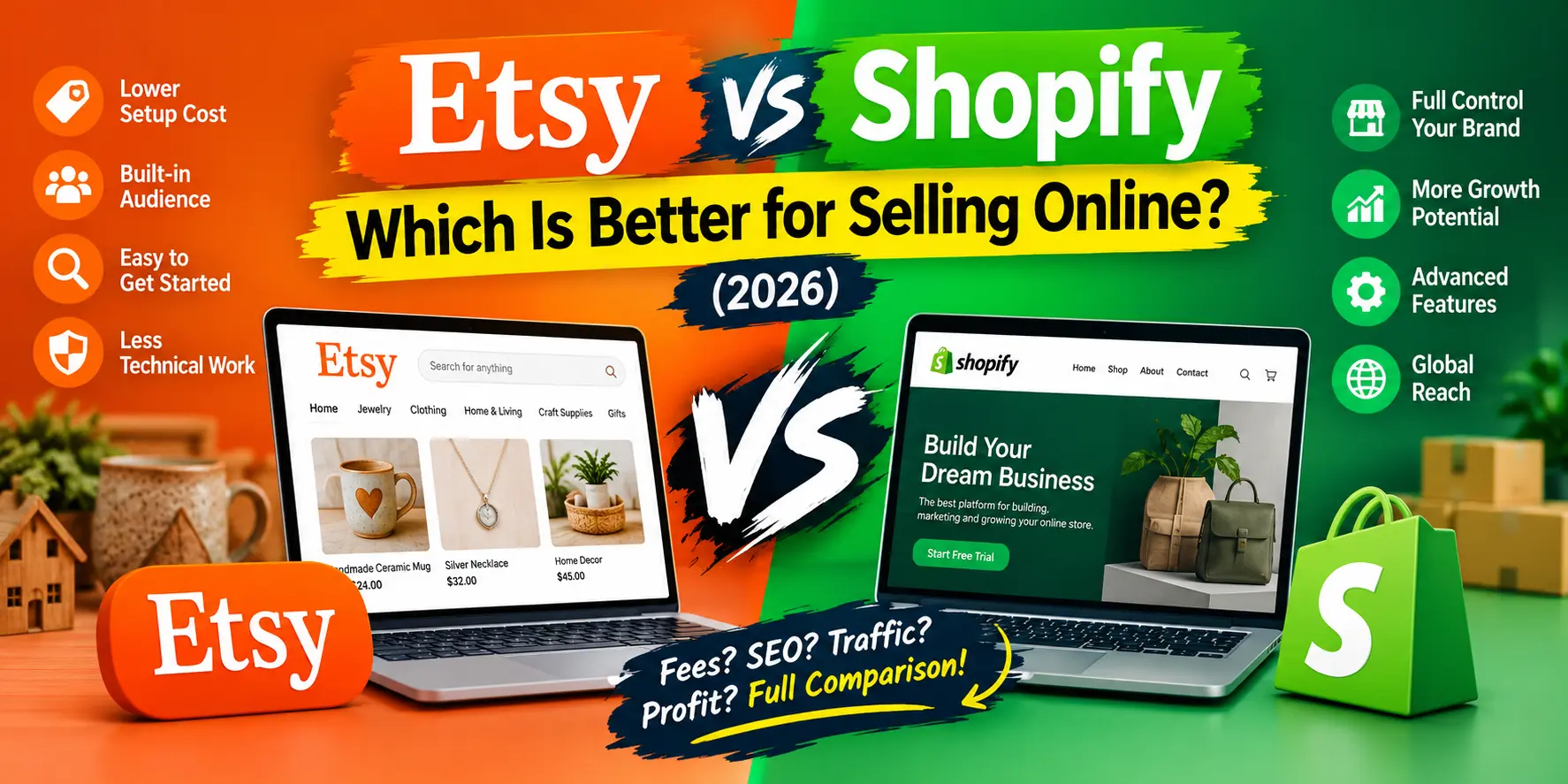
If you’re stuck on Etsy vs Shopify, you’re really asking one question: do you want to rent a stall in a busy market, or build your own shop? Etsy hands you shoppers but keeps a slice of every sale. Shopify hands you the keys but expects you to bring the shoppers.
This guide skips the vague pros and cons. You’ll see the real fee math at $500, $1,000, $5,000 and $10,000 a month, what each platform lets you sell, and exactly who should pick which.
Fees and plans last checked: October 2026. Prices change, so confirm on each platform before you decide.
Etsy vs Shopify: The Quick Verdict
- Pick Etsy if you sell handmade, vintage, craft supplies or designed items, you’re starting with little money and no audience, and you want a chance at sales this week.
- Pick Shopify if you want your own brand, you expect to sell more than a few hundred dollars a month, you sell things Etsy doesn’t allow, or you want to own your customer list.
- Use both if you sell handmade products and want Etsy’s shoppers while you build a brand of your own.
- On fees alone, Shopify usually costs less once you pass roughly 8 to 10 orders a month. Etsy brings the buyers; Shopify makes you find them.
What Is the Real Difference Between Etsy and Shopify?
Etsy is a marketplace. Your shop lives inside Etsy, uses Etsy’s layout, and competes on the same results page as thousands of other sellers. Shopify is a store platform. You build your own website, own your domain, and control the whole experience.
That one difference drives almost everything else: who owns the customer, how much you pay, how much traffic you get for free, and how far you can grow.
| Etsy | Shopify | |
|---|---|---|
| What it is | A marketplace | A store-building platform |
| Built-in traffic | Yes, shoppers search Etsy directly | No, you bring your own |
| Branding | Limited, within Etsy’s layout | Full control of design and domain |
| Customer relationship | Etsy owns the platform and much of the data | You own your customer list |
| Cost to start | No monthly fee, pay per listing and sale | Monthly plan plus payment fees |
| What you can sell | Handmade, vintage, craft supplies and designed items | Almost any legal product |
| Best for | Makers and small, testing-stage sellers | Brands, growing stores, dropshippers |
One thing I’ve learned is that running a Shopify store is about much more than just setting up a website and adding products. What surprised me most is how much trust, product presentation, and customer experience matter, so my advice to new sellers is to start small, test your products, and focus on understanding your customers before spending too much on ads.
Shopify vs Etsy Fees: What You’ll Actually Pay
Fees are where most Etsy vs Shopify comparisons get fuzzy. Here are the numbers for US sellers, then the math.
What Etsy charges
- Listing fee: $0.20 per listing.
- Transaction fee: 6.5% of the item price plus shipping.
- Payment processing: 3% + $0.25 per order in the US. UK sellers pay a different rate, currently 4% + £0.20.
- Offsite Ads (when they apply): an extra 15% on sales that come from Etsy’s ads on other sites, or 12% once a shop passes $10,000 in yearly sales. The fee is capped at $100 per order.
Etsy publishes its current rates on its fees and payments policy.
What Shopify charges
- Monthly plan: the Basic plan has been listed at about $29 a month billed annually, or $39 month to month. Grow and Advanced cost more and lower your card rates.
- Payment processing: with Shopify Payments, about 2.9% + $0.30 per online sale on Basic.
- Third-party gateway fee: if you don’t use Shopify Payments, Shopify adds a 2% fee on Basic on top of your payment provider’s rates.
- Extras: a domain, a paid theme if you want one, and any apps you install.
Shopify Payments isn’t available in every country, so check yours first. You can see all plans on Shopify’s pricing page.
The fee math, side by side
Here’s what each platform charges in fees alone at four sales levels. I assumed a $50 average order, US rates, no ads, no apps, and Shopify Basic billed annually with Shopify Payments.
| Monthly sales | Etsy fees | Shopify Basic fees | Cheaper on fees |
|---|---|---|---|
| $500 (10 orders) | $52 (10.4%) | $46 (9.3%) | Shopify by about $6 |
| $1,000 (20 orders) | $104 (10.4%) | $64 (6.4%) | Shopify by about $40 |
| $5,000 (100 orders) | $520 (10.4%) | $204 (4.1%) | Shopify by about $316 |
| $10,000 (200 orders) | $1,040 (10.4%) | $379 (3.8%) | Shopify by about $661 |
Run the same numbers for your own average order. Etsy’s cost grows in a straight line, while Shopify has a flat plan fee, so Shopify pulls ahead as volume rises. In this example the break-even is about nine orders a month, or roughly $450 in sales.
The costs that don’t show up in the table
- Traffic. Etsy’s fee includes the shoppers. On Shopify, you pay for traffic with time or ad spend.
- Offsite Ads. They can double Etsy’s cost on the orders they bring in.
- Shopify extras. Apps, a premium theme and a domain add up. Budget for them.
- Currency and shipping. Etsy’s 6.5% applies to shipping, too, so free shipping doesn’t escape the fee.
Want to see your own margin? Use our free dropshipping profit calculator and swap in your product cost, price and fees.
Selling more than a handful of orders a month?
That’s usually where Shopify’s lower per-order fees start to pay off. You can try it before you commit.
Try Shopify free →Traffic: Etsy Brings Buyers, Shopify Makes You Find Them
This is Etsy’s biggest advantage, and it’s the reason many sellers stay. Millions of people open Etsy already wanting to buy something handmade or unique. Your listing can get seen on day one without you spending on ads.
A new Shopify store starts with zero visitors. The upside is that you own the traffic you build, and none of it can be taken away by a policy change. These are the main ways to get it:
- Search (SEO). Product pages, collection pages and helpful blog posts can bring steady visitors over time.
- Pinterest. It works like a visual search engine and suits products people plan to buy. Our guide to a Pinterest traffic strategy shows how.
- Short video. Tools like CapCut make product videos easier to edit, and platforms such as TikTok for Business let you promote them. Paid options like TikTok Ads can speed things up if you have a budget.
- Email. A list is the one audience nobody can take from you. Tools like Kit (ConvertKit), Beehiiv, GetResponse and AWeber let you collect emails and follow up with buyers.
If you only want to test an idea quickly, Etsy’s traffic is hard to beat. If you want a business that doesn’t depend on one marketplace, build the Shopify side too.
Branding and Customer Ownership
On Etsy, buyers often remember the marketplace, not your brand. Your shop uses Etsy’s template, and the customer relationship runs through Etsy’s platform. You can build a following, but you’re doing it inside someone else’s walls.
On Shopify, you choose the theme, the domain, the checkout experience and the follow-up emails. You can run discounts, collect emails, and bring people back without paying a marketplace to introduce you again. That matters a lot if you sell products people buy more than once.
Rule of thumb: if repeat customers are part of your plan, own the relationship. That points to Shopify.
What You Can Sell: Etsy’s Rules vs Shopify’s Freedom
Etsy focuses on handmade items, vintage goods, craft supplies, and items you design, including some made with a production partner you disclose. It’s not the place for reselling mass-produced goods you didn’t make or design. Read the current creativity standards before you list anything.
Shopify has no such restriction. As long as the product is legal, you can sell it: your own brand, wholesale goods, print on demand or dropshipped items. If that’s your model, a few tools are worth a look:
- Sourcing and fulfillment: CJdropshipping and HyperSKU.
- Product and ad research: Minea and PiPiAds.
Check your margins before you commit. Our dropshipping profit calculator makes that quick.
Ease of Use: Which Is Faster to Launch?
Etsy wins on speed. You open a shop, upload photos, write descriptions, set prices and you’re live. There’s no site to design.
Shopify takes longer because you’re building a store: choosing a theme, setting up pages, payments, shipping and policies. It’s still beginner-friendly, and you don’t need to code. Expect a few days to get it feeling right, not a few hours. If you’re weighing other no-code options, our easiest site builder guide compares more of them.
Can You Sell on Etsy and Shopify at the Same Time?
Yes, and plenty of sellers do. Etsy works as a discovery engine and Shopify works as the brand home. The simple version is: let Etsy find the customers, give them an excellent experience, and use your Shopify store for your own marketing and repeat buyers.
Two cautions. Keep inventory in sync so you don’t oversell, and follow Etsy’s seller policies about moving buyers off the platform. Read them before you start.
Set up your Shopify store →Etsy or Shopify: Which Should You Choose?
Stop at the first line that sounds like you.
| If you… | Choose |
|---|---|
| Make handmade or vintage items and want quick sales | Etsy |
| Want to test a product idea with almost no upfront cost | Etsy |
| Want your own brand and customer list | Shopify |
| Sell dropshipped, print on demand or branded products | Shopify |
| Expect steady monthly sales above a few hundred dollars | Shopify for lower per-order fees |
| Make handmade products and want to grow a brand | Both |
| Sell digital downloads like templates or planners | Etsy to start, Shopify to scale |
Still unsure? Start on Etsy to prove people want what you make, then add Shopify when sales are steady. It’s the lowest-risk path for most makers.
How to Move From Etsy to Shopify Without Losing Sales
- Keep your Etsy shop open. Don’t close it while you build.
- Build the Shopify store in parallel. Add your best products first.
- Start collecting emails. Include a card or thank-you note that points happy customers to your brand, within Etsy’s rules.
- Drive traffic to the store through search, Pinterest, video and email.
- Shift gradually. Watch which platform earns more per order and adjust.
Common Mistakes When Choosing Between Etsy and Shopify
- Comparing only the monthly price. Traffic and ads are part of the cost.
- Expecting Shopify to bring customers on day one. It doesn’t.
- Ignoring Etsy’s rules and listing products that don’t qualify.
- Relying on one platform. A policy change can hit your income overnight.
- Skipping your own margin math. Fees, shipping and product cost together decide profit.
- Not building an email list. It’s the one asset you fully own.
Frequently Asked Questions
Etsy vs Shopify: which is better?
It depends on what you sell and how you plan to get customers. Etsy is better for handmade, vintage and craft items when you want built-in shoppers and a fast start. Shopify is better when you want your own brand, lower fees as sales grow, and the freedom to sell products Etsy doesn’t allow.
Is Shopify cheaper than Etsy?
Once you sell more than roughly 8 to 10 orders a month at an average of $50, Shopify’s fees are usually lower, because Etsy takes about 10% per sale before ads. Shopify has a monthly plan fee, and you also pay for traffic, apps and your domain, so compare total costs, not just platform fees.
How much does Etsy take from each sale?
On a typical US sale, Etsy charges a $0.20 listing fee, a 6.5% transaction fee on the item price plus shipping, and 3% + $0.25 payment processing. That’s roughly 10% before any advertising. If a sale comes through Etsy’s Offsite Ads, an extra 15% applies, or 12% for shops above $10,000 in yearly sales.
How much does Shopify cost per month?
Shopify’s core plans are Basic, Grow and Advanced. Basic has been listed at around $29 a month when billed annually and $39 month to month. Shopify Payments adds about 2.9% + $0.30 per online sale on Basic. Prices change, so check Shopify’s current pricing page before you decide.
Is it better to start on Etsy or Shopify as a beginner?
If you sell something Etsy allows and you have no audience yet, starting on Etsy is usually faster because shoppers are already there. If you want to build a brand, sell non-handmade products or own your customer list from day one, start on Shopify.
Can I sell on Etsy and Shopify at the same time?
Yes. Many sellers use Etsy to get discovered and Shopify as their own brand home. Follow Etsy’s seller policies, especially around directing buyers off the platform, and keep your inventory in sync.
Which platform gets more traffic, Etsy or Shopify?
Etsy, by default. It’s a marketplace where shoppers come to search. A new Shopify store starts with no built-in traffic, so you need SEO, social media, email or ads to get visitors.
Etsy vs Shopify for dropshipping or print on demand: which is better?
Shopify is usually the safer fit for dropshipping, because Etsy’s rules focus on handmade, vintage, craft supplies and items you design or have made by a production partner you disclose. Always read Etsy’s current creativity standards before listing anything.
Does Shopify have a free plan?
Shopify doesn’t offer a permanent free plan, but it does offer a free trial. Etsy is free to open a shop, and you pay per listing and per sale.
Is Shopify or Etsy better for digital products?
Both work. Etsy gives you a built-in audience for popular digital downloads like templates and planners, while Shopify gives you more control over branding, bundles and email follow-up, usually with an app for file delivery.
Final Thoughts
In the Shopify vs Etsy debate, neither wins everywhere. Etsy gives you shoppers and a fast start at the cost of higher per-order fees and less control. Shopify gives you your own brand, lower fees as you grow and more freedom in what you sell, but you have to earn the traffic.
If you make handmade goods and need your first sales, start on Etsy. If you’re building a brand, selling at volume, or selling anything Etsy doesn’t allow, build on Shopify. And if you can do both, use Etsy to get found and Shopify to keep the customers.
Ready to build a store you own?
Try Shopify and see how it feels before you commit.
Start your free Shopify trial →